Carpooling App Development: Everything You Need to Know
Carpooling has rapidly become one of the most practical solutions for modern transportation problems. With rising fuel prices, increasing traffic congestion, and growing environmental concerns, users are actively shifting toward shared mobility solutions. This shift has created strong demand for carpooling app development and related mobility platforms.
Today, businesses looking to enter the transportation industry are investing in solutions like ride sharing, taxi booking, and on-demand mobility platforms. A reliable taxi booking app development company or taxi app development company can help build scalable solutions that support real-time ride matching, payments, and route optimization.
This blog explains everything you need to know about building a successful carpooling app, including features, development process, technology stack, cost, challenges, and future trends.
What is a Carpooling App?
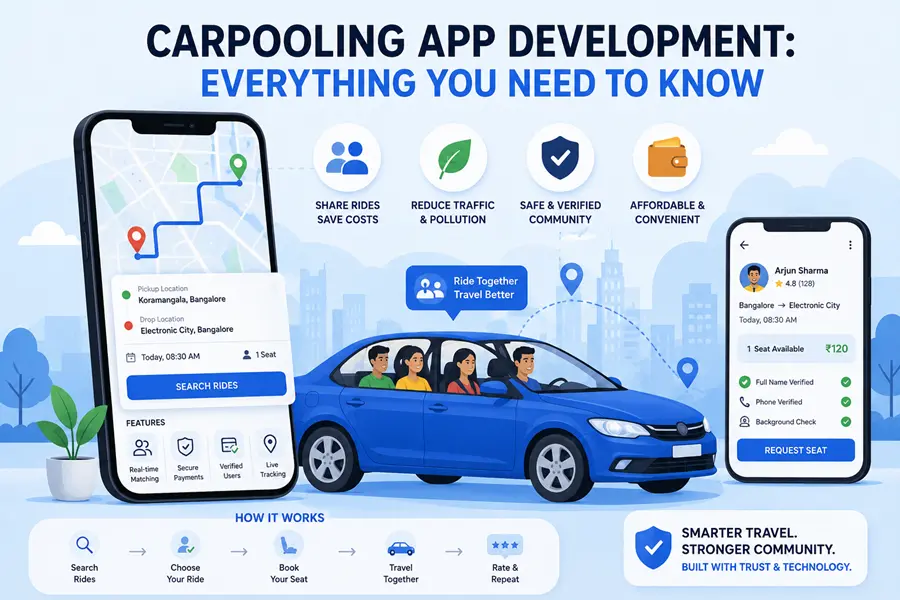
A carpooling app is a digital platform that connects drivers and passengers who are traveling in the same direction. The main idea behind carpooling app development is to optimize empty seats in private vehicles and allow users to share rides in exchange for a reduced travel cost.
Unlike traditional taxi services where a single passenger books a dedicated ride, carpooling focuses on shared travel. A driver who is already planning a trip can publish their route, and multiple passengers can join that ride if their destinations match. This creates a cost-effective and environmentally friendly transportation model.
Many companies working in ride sharing app development are expanding their platforms to include both taxi-style bookings and carpooling features, making mobility apps more flexible and profitable.
Why Carpooling Apps Are Growing So Fast
The rise of carpooling apps is not accidental—it is driven by real-world transportation challenges and changing user expectations. Businesses investing in carpooling app development are targeting a rapidly growing market where affordability and convenience matter more than ownership.
1. Rising Fuel and Travel Costs
Fuel prices continue to increase globally, directly impacting daily commuters. Carpooling apps allow users to split travel expenses, making commuting significantly cheaper. For drivers, it creates an opportunity to recover fuel costs while offering unused seats. This economic balance is one of the strongest reasons behind the popularity of shared mobility platforms.
2. Heavy Traffic Congestion
Urban cities are facing severe traffic congestion due to increasing vehicle density. Shared mobility solutions like carpooling and ride pooling help reduce the number of vehicles on roads. Companies offering ride sharing app development solutions focus heavily on optimizing routes to minimize traffic load and improve travel time.
3. Environmental Sustainability
Environmental awareness is growing among users. Carpooling reduces the number of vehicles on the road, which directly lowers carbon emissions. Many modern apps now include carbon-saving trackers to show users their environmental impact, making the platform more engaging and meaningful.
4. Affordable Mobility for Users
Traditional taxi services can be expensive for daily commuting. Carpooling provides a budget-friendly alternative. Users pay only for shared seats, making it ideal for students, office workers, and frequent travellers. This affordability factor is a key reason why businesses prefer investing in carpooling app development solutions.
5. Growth of Smart Mobility Ecosystems
Smart cities and digital transportation networks are growing worldwide. Governments and private companies are supporting shared mobility initiatives. This creates a strong ecosystem where taxi app development company solutions are evolving into integrated mobility platforms that include taxis, carpools, and ride-sharing options in one app.
Also Read: - How to Launch a Profitable Taxi Booking App in 2026
Types of Carpooling Apps
Understanding different types of carpooling models is important before starting carpooling app development, as each model targets a different user base and business strategy.
1. Daily Commute Carpooling Apps
These apps are designed for users who travel regularly between home and office or school. The system matches users with similar daily routes and timings. This type of app focuses heavily on repeat usage, route optimization, and scheduling features. Many ride sharing app development platforms prioritize this model due to its stable user demand.
2. Long-Distance Carpooling Apps
Long-distance carpooling apps focus on intercity travel. Users traveling from one city to another can share rides and split costs. These platforms require strong route-matching algorithms and trust-building features because users are traveling longer distances with strangers.
3. Corporate Carpooling Apps
Corporate carpooling solutions are designed for companies that want to manage employee transportation efficiently. Businesses use these apps to reduce transportation costs and improve employee convenience. Many taxi booking app development company services also offer enterprise mobility solutions as part of their offerings.
4. Event-Based Carpooling Apps
These apps are used during high-demand events like concerts, sports matches, and festivals. They help users find shared rides for specific locations and timeframes. The demand spikes during events, so the system must handle high traffic and real-time updates efficiently.
Key Features of a Carpooling App
A successful carpooling app development project requires a strong feature set for passengers, drivers, and admins. These features ensure smooth operations and user satisfaction.
Passenger App Features
Passenger-side features are the core of any ride-sharing platform. Users should be able to register easily, search for rides, and book seats in just a few steps. Real-time ride availability and fare estimation are essential for transparency. Features like live tracking, in-app chat, and multiple payment options (UPI, cards, wallets) improve trust and usability. Ratings and reviews also help maintain service quality across the platform.
Driver App Features
Drivers need tools to manage rides efficiently. A well-designed ride sharing app development system includes driver onboarding, document verification, ride creation, and route selection. Drivers should also be able to manage seat availability, track earnings, receive ride requests, and navigate using integrated maps. A smooth driver experience ensures better supply on the platform.
Admin Panel Features
The admin dashboard is the control center of the platform. It includes user management, driver approvals, ride monitoring, commission tracking, and analytics. Fraud detection and dispute management are also critical features. A taxi app development company usually focuses heavily on admin tools because they ensure long-term platform stability and scalability.
Must Read: - How Can a Taxi App Development Company Help You Launch Faster?
Advanced Features for a Competitive Carpooling App
To stand out in the market, modern carpooling app development must include advanced features that enhance performance, safety, and user engagement.
AI-based route matching is one of the most important features. It automatically connects drivers and passengers with similar routes, reducing travel time and improving efficiency. Dynamic pricing adjusts fares based on demand, distance, and traffic conditions, ensuring fair pricing for both users and drivers.
Geo-fencing helps control ride availability within specific regions, while SOS emergency features improve safety. Scheduled rides allow users to plan their daily commute in advance. Many taxi booking app development company solutions now also include carbon tracking features, which show users how much CO₂ they have saved through shared rides.
Technology Stack for Carpooling App Development
A strong technology foundation is essential for building scalable mobility solutions. Most ride sharing app development platforms use modern technologies to ensure speed and reliability.
Frontend development is typically done using Flutter or React Native for cross-platform apps. Native development using Kotlin and Swift is also used for high-performance applications. The backend is usually built with Node.js, Django, or Spring Boot depending on scalability requirements.
Databases like MongoDB and PostgreSQL manage structured and unstructured data, while Redis handles caching and real-time updates. Google Maps API or Mapbox is used for navigation and route tracking. Payment integration is handled through Razorpay, Stripe, or PayPal, depending on the region.
Cloud platforms like AWS or Google Cloud ensure scalability and uptime, especially for high-traffic carpooling systems.
Also Read: - How to Choose the Right Budget-Friendly Taxi App Development Company
Carpooling App Development Process
The carpooling app development process follows a structured approach to ensure quality and performance.
It starts with requirement analysis, where business goals, target audience, and features are defined. UI/UX design follows, focusing on simple and user-friendly interfaces for both drivers and passengers. The architecture planning stage defines backend systems, APIs, and database structure.
Development is done in phases, with frontend and backend built simultaneously. API integration connects maps, payments, and notifications. Testing includes functional, performance, and security testing to ensure stability. Finally, the app is deployed on app stores and maintained with regular updates.
A professional taxi app development company ensures that each stage is executed with scalability and performance in mind.
Cost of Carpooling App Development
The cost of building a carpooling app depends on complexity and features.
A basic app with limited functionality can cost between $8,000 and $15,000. Mid-level apps with real-time tracking and payment integration may cost between $15,000 and $40,000. Advanced platforms with AI-based matching and enterprise features can exceed $100,000.
The final cost depends on platform selection (Android, iOS, or both), design quality, third-party integrations, and the experience of the taxi booking app development company or development team.
Challenges in Carpooling App Development
Building a successful ride sharing app development platform comes with several challenges.
User adoption is one of the biggest challenges, as convincing users to switch from private or taxi rides to shared mobility takes time. Safety concerns also play a major role, requiring strong verification systems and real-time tracking features.
Route optimization is technically complex and requires advanced algorithms. Real-time performance is another challenge, especially when handling thousands of users simultaneously. Legal regulations vary by region and must be carefully followed to avoid compliance issues.
Must Read: - How Much Does It Cost to Develop a Taxi App Like inDrive?
Monetization Strategies
A carpooling platform can generate revenue in multiple ways. The commission model is the most common, where the platform charges a small percentage on each ride. Subscription plans offer premium features for frequent users.
Advertising can also be integrated to promote local businesses. Surge pricing during peak hours increases revenue, while corporate partnerships with companies provide steady income streams. Many taxi app development company solutions combine multiple monetization models for maximum profitability.
Future of Carpooling and Ride Sharing Apps
The future of carpooling app development is closely tied to AI, automation, and electric vehicles. AI will play a major role in predictive matching and route optimization. Electric vehicles will make shared mobility more sustainable.
Autonomous vehicles may further transform the industry by removing driver dependency. Smart city integration will allow seamless transportation planning. Blockchain-based systems may improve payment security and transparency.
As transportation continues to evolve, ride sharing app development will become a core part of urban mobility ecosystems worldwide.
Conclusion
Carpooling app development is one of the most promising opportunities in the mobility industry. With the right strategy, technology, and features, businesses can build scalable platforms that serve both drivers and passengers efficiently.
Whether you are working with a taxi booking app development company or building your own platform, the focus should always be on user experience, safety, and performance. The combination of shared mobility, smart technology, and growing demand makes this industry highly profitable and future-ready.